
How To
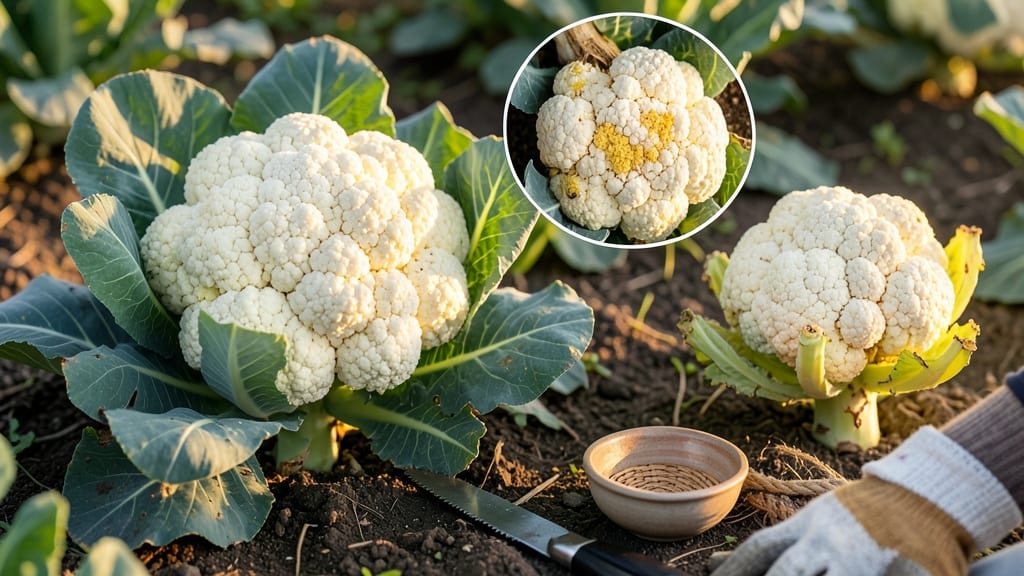
Knowing when to harvest cauliflower 🥬 means catching it at the peak of crispness—before it turns bitter or bolts into a floral mess.
Picking too early gives you a tiny, underdeveloped head, while waiting too long means a tough, yellowing curd that’s past its prime. The trick?
Watch for three key signs: a firm, compact head the size of a softball, consistent color (creamy white, purple, or green, depending on the variety), and leaves that stay tightly wrapped.
Temperature and weather play a role too—cool, cloudy days slow maturity, while heat speeds it up. Below, I’ll walk you through the exact visual cues, how to test firmness, and what to do if your cauliflower starts bolting before harvest time.
By the end, you’ll never second-guess whether your 🥬 is ready—or left too long on the stalk.
3 Key signs your cauliflower is ready for harvest (curd color, size & knob tightness)
There’s nothing worse than slicing into a cauliflower only to find it’s either too small or bitter from overmaturity. Knowing the exact moment to harvest ensures you get that perfectly tender, flavorful head. The good news?
It’s all about paying attention to three key visual and physical cues—curd color, head size, and knob tightness. These signs work for standard white varieties and even purple or orange cauliflower, though the color targets differ slightly.
First, let’s talk about curd color, because this is your first clue. A ripe cauliflower’s head should be a uniform shade—whether that’s creamy white, pale green, deep purple, or orange—with no yellowing or browning.
If you see green streaks on white varieties, that’s a sign it’s been exposed to too much sun, which can make the curd tough and bitter. For purple varieties, the color should be vibrant, not faded or washed out.
Next, check the head size. A fully mature cauliflower should measure between 6 to 8 inches in diameter. If it’s smaller than a golf ball, it’s likely still growing.
On the flip side, if it’s larger than a softball, it may have already started to bolt or develop loose florets, which affects texture and taste.
Pro tip: Mini cauliflower varieties (like Purple of Sicily) will be ready at 3 to 4 inches, so always check the seed packet for variety-specific guidelines.
Now for the knob tightness test, which is the most reliable way to gauge readiness. Gently squeeze the head near the base—it should feel firm and dense, almost like a tightly packed ball. If it feels squishy or hollow, it’s overripe.
You should also see that the outer leaves are still closed and snug around the head, not spreading apart. This is your plant’s way of protecting the curd while it matures.
- 1 Curd Color Check: Look for a uniform color—creamy white, pale green, purple, or orange—with no yellowing. Avoid heads with green streaks (sun exposure) or brown spots (rot or pests).
- 2 Head Size: Measure the diameter—6 to 8 inches for standard varieties, 3 to 4 inches for mini types. Use your hands: a ripe head should be about the size of a softball or slightly smaller.
- 3 Knob Tightness Test: Gently squeeze the head—it should feel firm and dense, not hollow or spongy. The outer leaves should remain closed and snug, not spreading apart.
- 4 Floret Check: Peek at the center florets—they should be tightly packed and not starting to open. If you see yellow or brown florets, the head is past its prime.
Timing your harvest correctly also depends on your climate and variety. In hotter weather, cauliflower can mature faster, so check daily. In cooler climates, it might take a few extra days.
If you’re growing Romanesco, wait until the fractal pattern is fully developed and the bumps are tight and green. For fall crops, harvest before the first frost hits, as cold temperatures can turn the curd woody and bitter.
One common mistake is waiting until the head is too large because you think it’s worth the wait. But oversized cauliflower heads often have loose florets and a woody core, which ruins the texture.
Similarly, harvesting too early results in a small, underdeveloped head that lacks flavor. The sweet spot is when all three signs—color, size, and tightness—align perfectly.
When you’re ready to harvest, use a sharp knife or pruners to cut the head about 1 inch below the curd. Leave the outer leaves intact—they protect the plant and can sometimes produce a second smaller head if conditions are right.
After harvesting, store your cauliflower in the fridge for up to 5 days or blanch and freeze it for long-term storage.
Pro tip: If your cauliflower starts to bolt (send up a tall flower stalk), it’s a sign it’s too mature for a quality harvest. This often happens in hot weather or if the plant is stressed.
To prevent bolting, keep your plants well-watered and shaded during peak heat with row covers or shade cloth.
Mastering these three key signs will transform your cauliflower harvests from hit-or-miss to consistently perfect. Next time you’re in the garden, take a moment to check these cues—your taste buds will thank you! 🥬
Common harvesting mistakes that ruin your cauliflower (and how to avoid them)
Harvesting cauliflower at the wrong time can turn your crisp, flavorful heads into bitter, woody messes. The most common mistake? Waiting too long until the curd turns yellow or florets open—this happens when the plant senses heat stress or daylight length changes.
Even worse, harvesting too early stunts the plant’s growth, leaving you with tiny, underdeveloped heads that never reach their full potential.
Another frequent issue is split heads, which occur when the curd outgrows its leaf blanket or faces uneven watering. Late-season bolting (when the plant sends up a flower stalk) can also ruin your harvest if you’re not prepared.
Each of these mistakes has a simple fix—if you know what to watch for.
⚠️ callout warning
Don’t guess—check these 3 signs before harvesting:
- Head size: 6-8 inches in diameter (softball-sized)
- Color: Consistent creamy white (or purple/green for heirloom varieties)
- Texture: Firm when gently squeezed—leaves should not be opening
❌ Overripe: Yellow florets or loose leaves = bitter, tough curd
✅ Perfect: Tight curd with closed florets = sweet, tender harvest
If you harvest too early, your cauliflower won’t develop fully, leaving you with small, loose heads that lack flavor. The plant may even regrow a second head if given time, but this is unreliable.
To avoid this, wait until the curd is firm and compact—never harvest based on days alone, as temperature and variety affect maturity.
Late-season bolting is another headache, especially in hot climates or when planted too early. If your cauliflower bolts, the head may never form properly. To prevent this, choose early-maturing varieties and plant in cool seasons. If bolting starts, harvest any small heads immediately—they’ll still be edible, just less ideal.
Split heads happen when the curd outgrows its leaf blanket or faces uneven watering. To fix this, ensure your plants have consistent moisture and enough space. If splits occur, harvest the edible parts immediately—they’re still tasty, just less uniform.
For future crops, use larger leaf varieties or tie leaves together with twine to protect the curd.
Finally, never harvest in direct sunlight—this stresses the plant and can cause bitterness. Always cut heads in the morning with a sharp knife, leaving 1-2 inches of stem attached. This keeps the plant healthy for potential side shoots, which may produce smaller heads later in the season.